
Appearance
Running Apps
Apps can run on the back-end or front-end in either development mode or runtime mode. The mode is set automatically based on the user’s authorization level. Development mode is available to administrators only, as other users are generally not authorized to access builders and wizards.
App builders are available from the app’s top toolbar for the master table. For relationships, builders are accessible via the builder buttons in the table and form footers. Builders are supported on both the back-end and front-end. Front-end builder access can be disabled using the shortcode parameter builders="false".
On the Back-End
🛠️ From the App Builder dashboard
Click the Run & Build App link or icon.
This feature allows administrators to customize apps without granting access to other users, providing a stable environment to test and refine apps before deployment.
📌 This feature is available exclusively to administrators from the App Builder dashboard.
🖥️ From the WordPress dashboard
Authorize users and/or roles to use an app.
The WordPress dashboard includes a navigation menu for accessing built-in and custom pages. Enabling this option adds a menu item to the dashboard for all authorized users, providing them with easy access to the app.
Authorization is managed via the App Manager. Administrators can access it from the App Builder dashboard by clicking the Manage App link or icon. Once authorized, a link to the app is automatically added to the user’s dashboard.
📌 Administrators must authorize specific users and/or roles.
> How do I authorize users and roles?
> How do I allows users to access apps in the back-end?
On the Front-End
</> Using a Shortcode
Use Shortcode
wpda_app.
An app can be embedded on the front-end using a shortcode. These shortcodes are generated through the App Manager.
Authorization is also managed via the App Manager, which administrators can access from the App Builder dashboard by clicking the Manage App link or icon.
📌 Administrators must authorize specific users and/or roles.
> How do I authorize users and roles?
> How do I generate a shortcode for front-end usage?
> Which plugin shortcode parameters are available?
> How can I use my own custom shortcode parameters?
✏️ Using the Gutenberg Block Editor
The WP Data Access App Block is a Gutenberg block that lets you embed any WP Data Access application directly into your WordPress pages and posts.
Adding the Block to Your Content
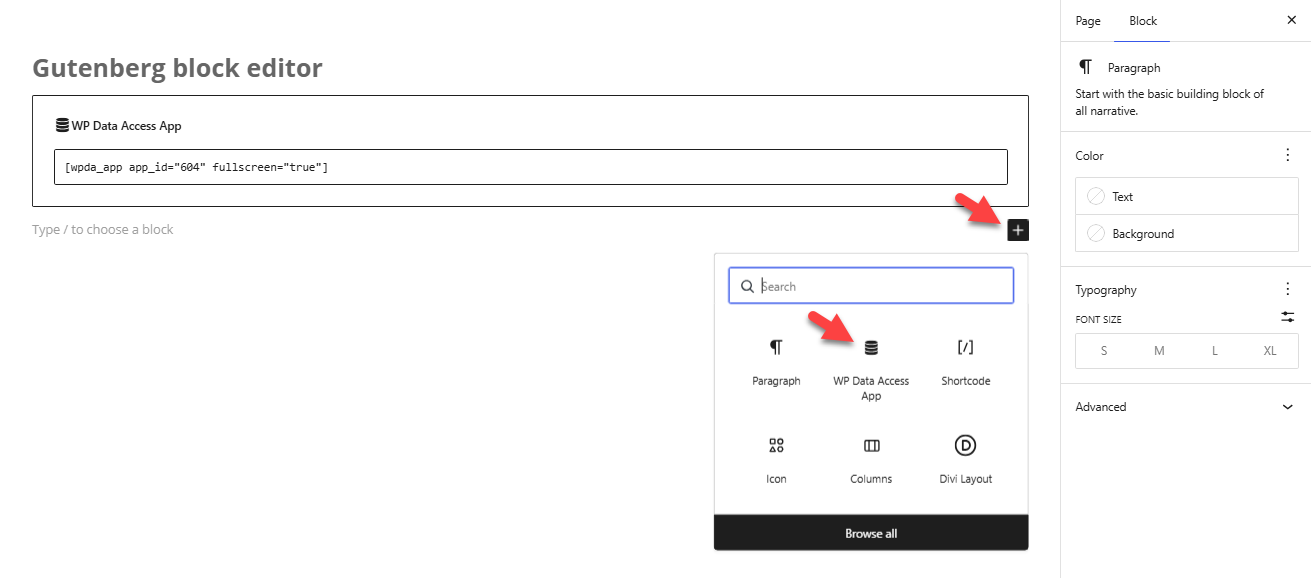
- Open the WordPress Block Editor (Gutenberg) for any post or page.
- Click the + (Block Inserter) button or type / in the content area.
- Search for "WP Data Access App" and select the block to add it to your page.
Configuring Your App
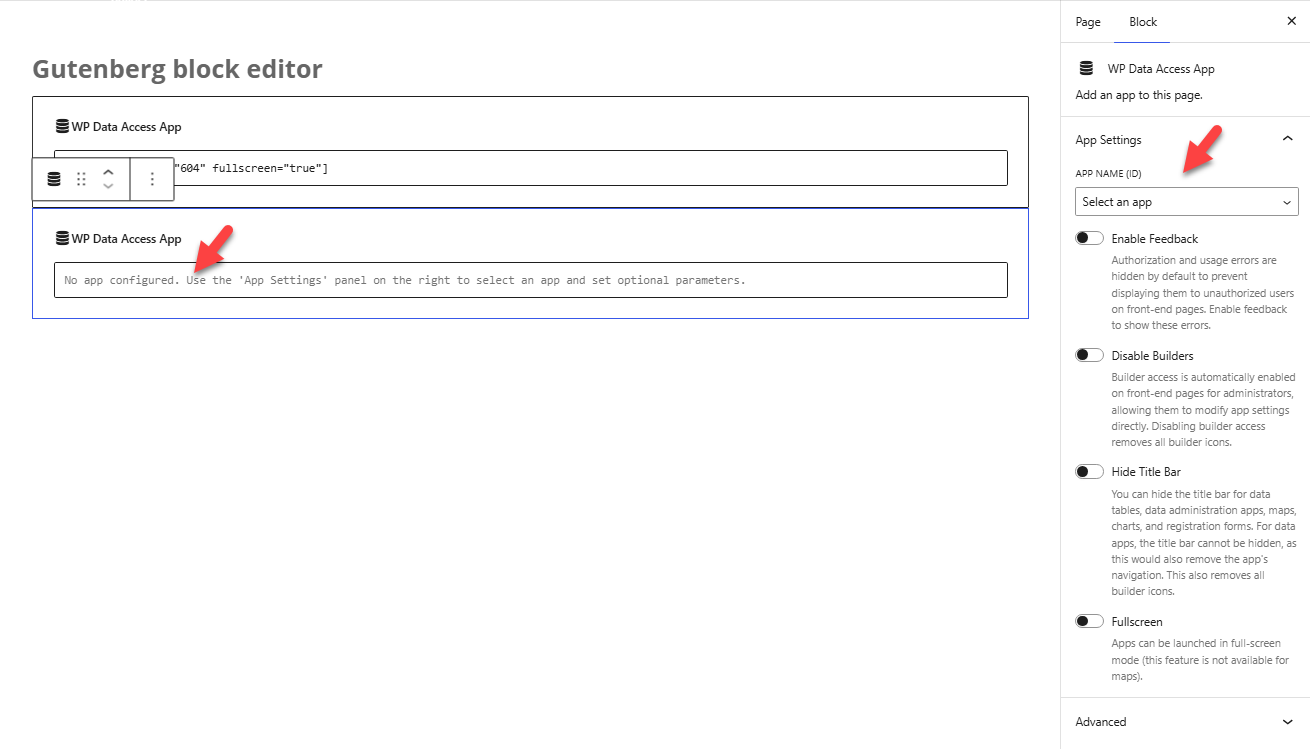
Once the block is added, you'll see the app settings panel in the block toolbar or sidebar.
From here, you can:
- Select your app – Choose from any WP Data Access App you've created.
- Configure display options – Adjust settings like layout, filters, or permissions as needed.
Viewing Your Page
After you save or publish the page, the app will load automatically when visitors view the page. No additional shortcodes or custom code are required.
Troubleshooting Tips
- If the app doesn't appear, make sure the user has the necessary permissions or user roles to view the app. You can adjust these in the App Manager.
- If you've just created a new app, try refreshing the editor or reloading the page to ensure the block recognizes it.
- Changes made to the app in WP Data Access Manager will automatically reflect on the frontend — no need to update the block itself.
As Progressive Web Apps (PWA)
A Progressive Web App (PWA) is a website that looks and behaves like a native mobile app. Built with standard web technologies (HTML, CSS, and JavaScript), PWAs combine the best of the web and the best of native apps. Unlike traditional apps, PWAs do not require installation from an app store; users can install them directly from the browser, making them easy to access and update.
Running a WP Data Access App as a PWA
Any WP Data Access app type can run as a PWA on a unique URL. These PWAs require minimal WordPress resource loading and have no styling interference with back-end or theme CSS. Visitors can add your PWA to their home screen and open it like a native app on Android, iOS, Windows, and macOS.
Creating a PWA
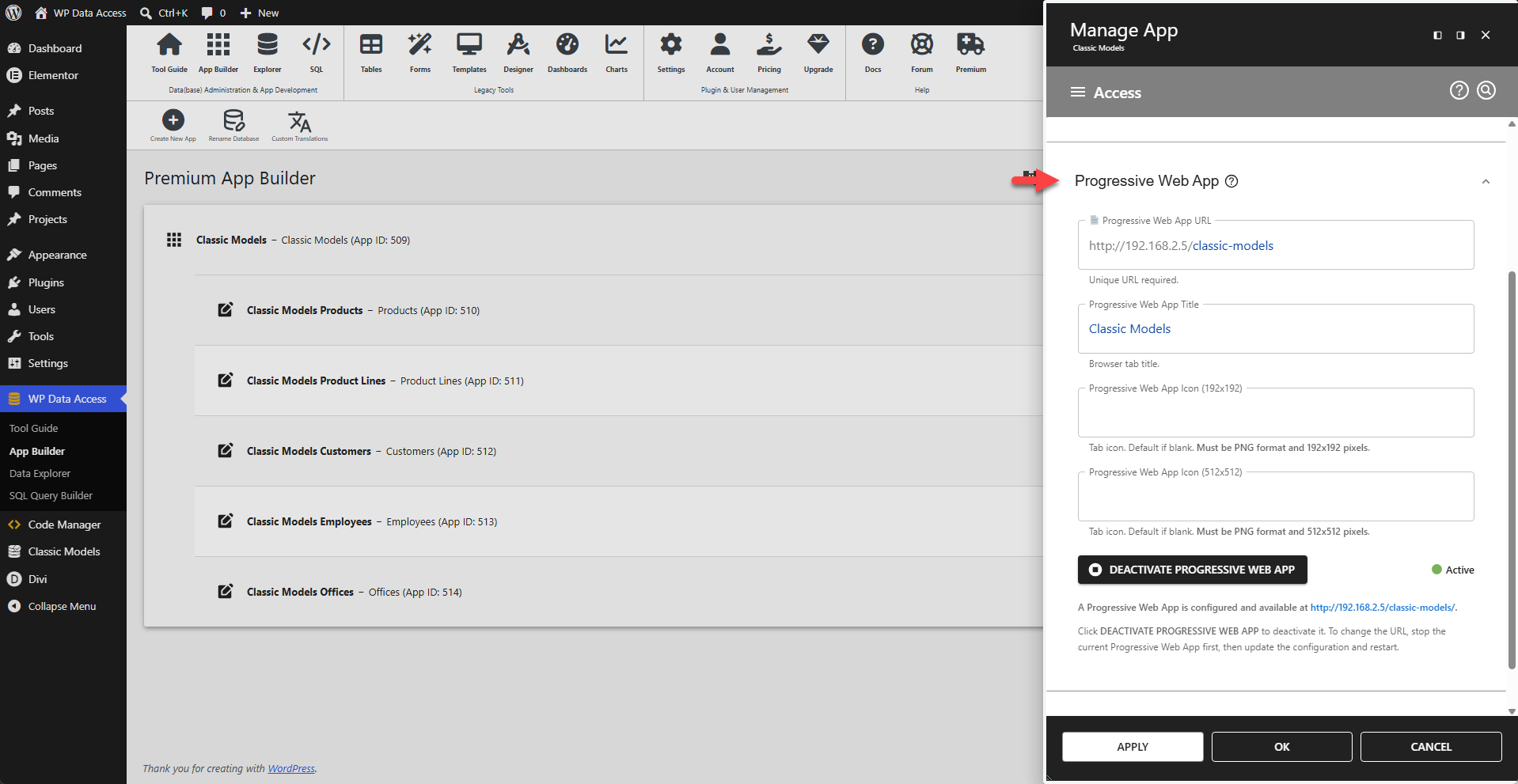
A PWA can be created and activated in the App Manager in the Access menu in the Progressive Web App section. Service workers and manifests are handled automatically, with no manual actions required. If a PWA requires authentication, the user will be redirected to the WordPress login page. Builders are available on PWA pages, allowing administrators to build apps directly on PWA pages.
Advantages
- Progressive Web Apps are accessible on their own unique URL
- Progressive Web Apps require minimal WordPress resource loading
- Progressive Web App styling does not interfere with back-end or theme CSS
- Service Worker caches pages and static files
- Installations and updates directly from the browser
- Reduced costs for mobile app development
Requirements
- HTTPS must be enabled – PWAs require a secure origin
Limitations
- Offline data handling is not supported